
How to Handle Flood Damage Cleanup in Charlotte the Right Way
Start Flood Damage Cleanup in Charlotte Within Hours
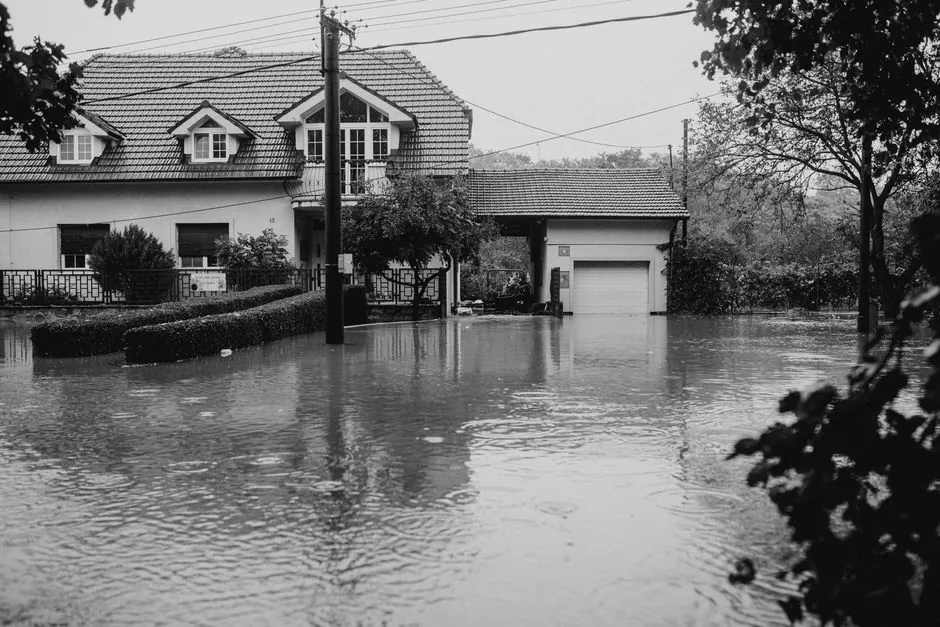
For flood damage cleanup Charlotte homeowners should first protect people, then stop further damage: avoid standing water near electrical outlets, shut off utilities only if it is safe, document the damage with photos, and remove water as soon as possible. Move dry belongings to a safe area, but do not enter rooms with sagging ceilings, damaged walls, or suspected sewage contamination.
Mold can begin growing in as little as 24 to 48 hours after water damage. Charlotte's heavy rain, humid summers, clay-rich soil, and stormwater runoff can make fast extraction and thorough drying especially important. A professional restoration team can assess contamination, extract water, dry hidden moisture in floors and walls, and help protect your home's structure and indoor air. For more on emergency response protocols, see the FEMA flood damage cleanup guide.

Immediate Steps and Safety Precautions After a Charlotte Flood
When floodwaters breach your home, the initial hours dictate the overall recovery timeline and cost. Knowing what to do after water damage occurs keeps your family safe and mitigates compounding structural losses.
Critical Safety Protocols
Before stepping foot into a flooded basement or living room, evaluate these immediate physical hazards:
- Electrical Risks: Never walk through standing water if the main breaker is still active. If you cannot reach the electrical panel safely from a dry area outside the flood zone, contact Duke Energy or a licensed electrician immediately.
- Structural Stability: Waterlogged drywall weighs several times its normal mass, placing extreme stress on wall fasteners and ceiling joists. Look out for sagging ceilings, buckled subfloors, and displaced support posts.
- Contaminant Protection: Floodwater rarely consists of clean tap water. Always wear heavy-duty rubber boots, nitrile gloves under work gloves, and an N95 or P100 respirator to avoid inhaling aerosolized bacteria or fungal spores.
- Utility Disconnects: In addition to electricity, shut off your main gas supply if you smell natural gas or suspect shifting foundations may have sheared underground supply lines.
Photo Documentation and Initial Mitigation
Before hauling out saturated carpeting or running extraction pumps, capture clear evidence for your insurance company. Take wide-angle photos and videos of every impacted room, including clear shots of the high-water line on baseboards and sheetrock. Document serial numbers and make/model tags on waterlogged appliances and electronics.
Understanding the classification of the water inside your property determines what protective measures and extraction equipment are necessary:
| Water Category | Contamination Level | Typical Sources in Charlotte | Required Safety Gear | Salvage Potential for Porous Items |
|---|---|---|---|---|
| Category 1 (Clean Water) | Low to none at source | Broken supply lines, overflowing sinks, rainwater leaks | Gloves, waterproof boots | High (if dried within 24–48 hours) |
| Category 2 (Gray Water) | Moderate (chemical or physical) | Washing machine overflows, dishwasher discharge, sump pump failure | Respirator (N95), nitrile gloves, eye protection, boots | Medium (carpeting may need disposal; padding always replaced) |
| Category 3 (Black Water) | High (pathogens, toxins, raw sewage) | Rising creek floodwaters, sewer line backups, surface runoff | Full PPE (Tyvek suit, P100 respirator, heavy chemical-resistant gloves, rubber boots) | Very Low (porous items like mattresses, drywall, and carpet must be discarded) |
Navigating Charlotte Weather Patterns and Local Flood Risks
Flooding across the Queen City is heavily shaped by local topography, historical development patterns, and distinctive soil conditions.
Mecklenburg County features a dense network of urban waterways. The Sugar Creek basin, Briar Creek, and Little Sugar Creek are notorious for rapid swelling during severe weather. In low-lying neighborhoods near the Catawba River and Mountain Island Lake, extended downpours cause reservoir overflow, pushing floodwaters deep into residential basements and crawl spaces.
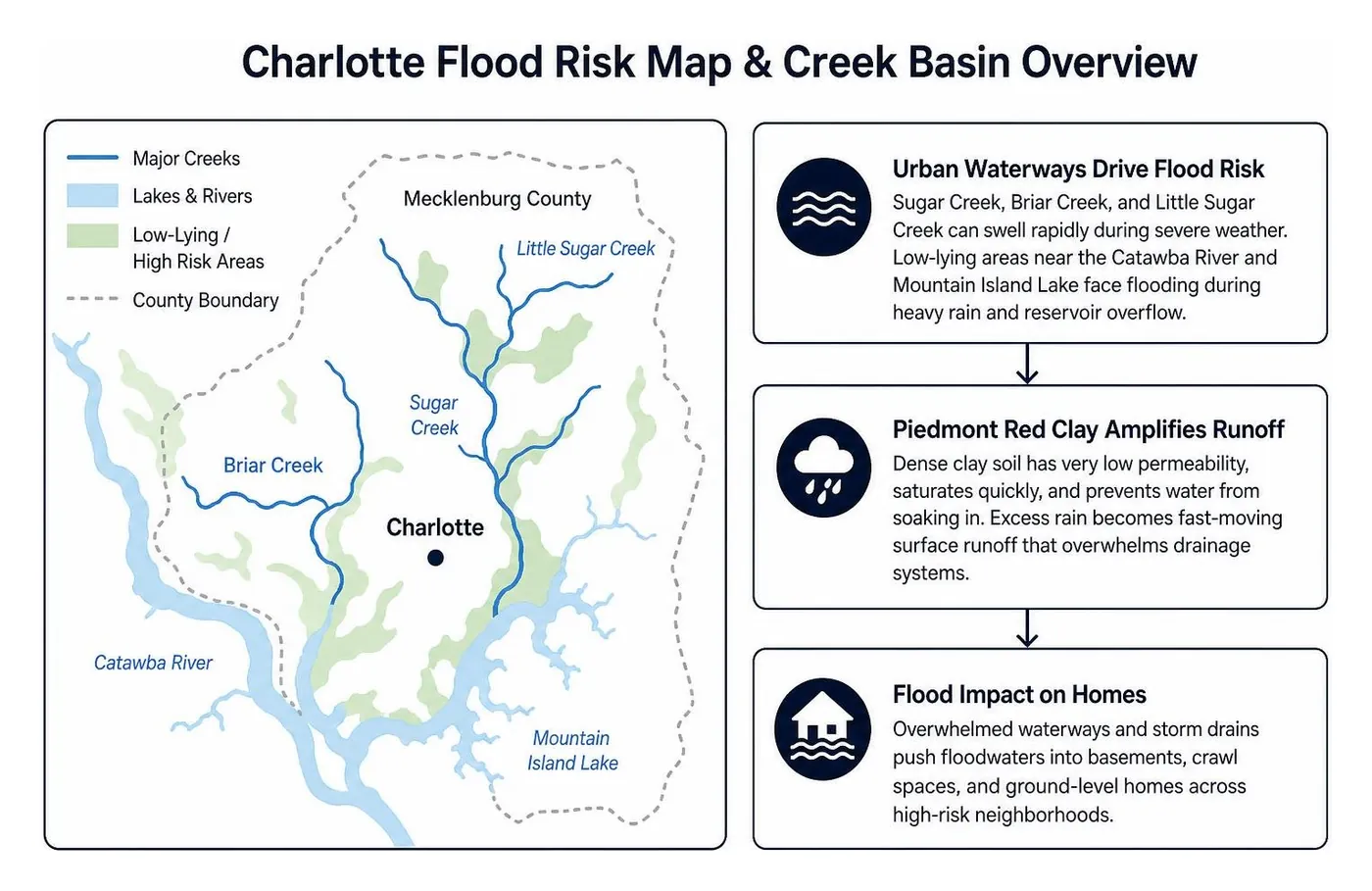
Compounding these waterway dynamics is the region's infamous Piedmont red clay soil. Because dense clay possesses exceptionally low permeability, it saturates quickly during intense rainfall. Instead of soaking deep into the earth, surplus rainwater turns into massive surface runoff. When tropical storm remnants move inland over North Carolina, this runoff overwhelms municipal stormwater infrastructure, forcing surface water directly against residential foundations and into crawl spaces.
Professional Flood Damage Cleanup Charlotte: What to Expect
Tackling extensive flood damage requires specialized techniques that go far beyond a standard mop and shop vac. Our comprehensive water damage restoration approach focuses on removing moisture at the molecular level, ensuring that hidden water pockets inside structural framing are completely eliminated.
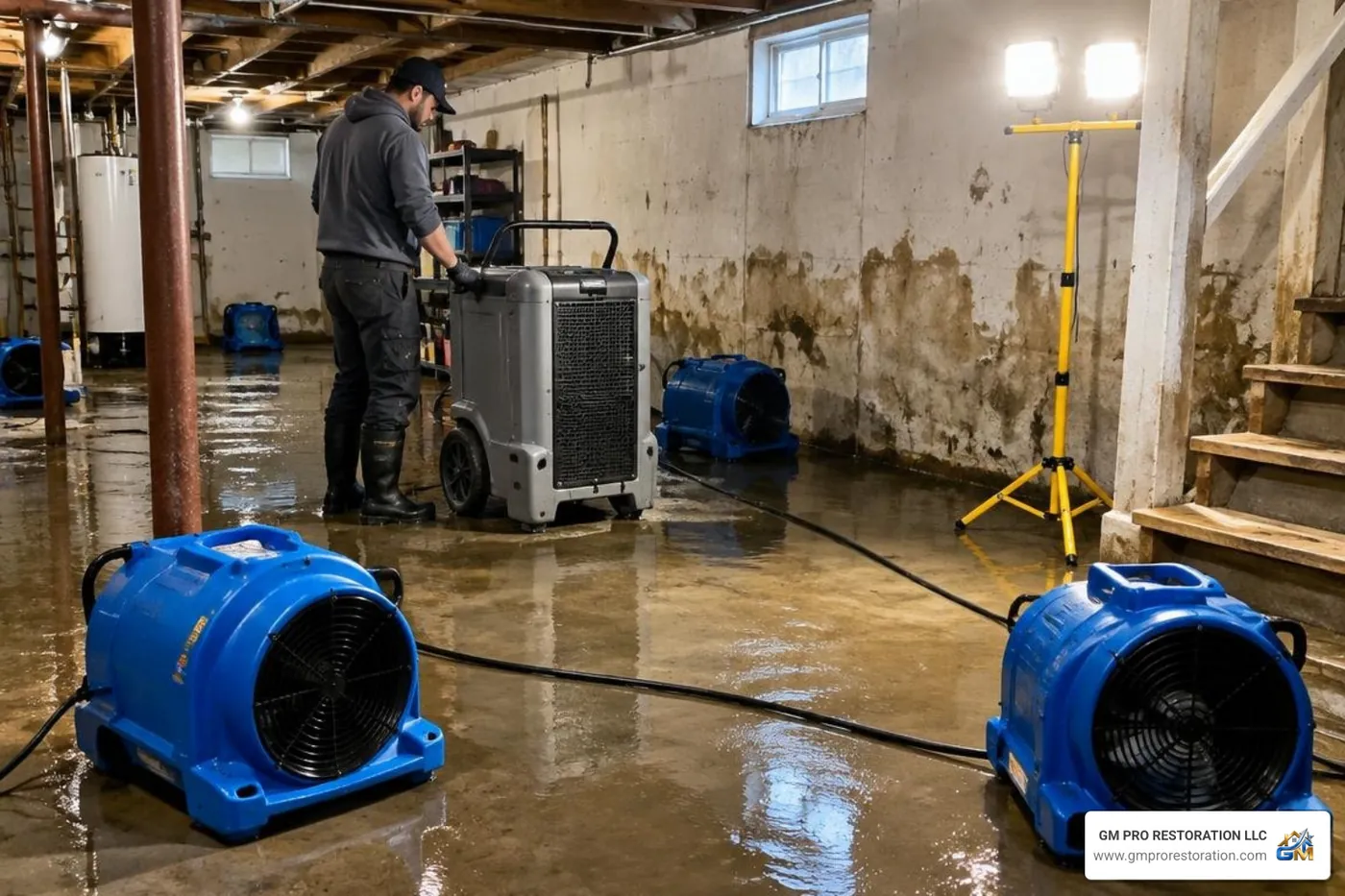
The professional remediation sequence follows a precise, scientifically driven methodology:
- Initial Inspection and Moisture Mapping: We deploy calibrated non-invasive moisture meters and high-resolution thermal imaging cameras. These tools pinpoint exact boundaries of moisture migration behind tile, inside wall cavities, and beneath finished hardwood floors without unnecessary demolition.
- Bulk Water Extraction: Truck-mounted and heavy-duty submersible pumps extract standing water rapidly. High-capacity extraction units pull deep-set moisture out of subflooring and carpet fibers to accelerate the subsequent evaporation phase.
- Controlled Demolition and Material Removal: Unsalvageable, contaminated porous materials—such as waterlogged insulation, warped baseboards, and soaked drywall cut several inches above the water line—are carefully removed and bagged.
- Structural Drying and Dehumidification: We place commercial-grade centrifugal air movers to create high-velocity airflow across surfaces, paired with industrial low-grain refrigerant (LGR) or desiccant dehumidifiers to pull evaporated water vapor directly out of the indoor air.
- Antimicrobial Treatment and Deep Cleaning: Every exposed stud, concrete slab, and subfloor is treated with EPA-registered botanical or hospital-grade antimicrobials to eliminate bacteria, viruses, and emerging fungal growth.
Hiring the Right Experts for Flood Damage Cleanup Charlotte
Entrusting your home to an unqualified contractor can lead to lingering structural rot, persistent odors, and toxic mold infestations. When selecting a cleanup team in Mecklenburg County, ensure they meet rigorous industry benchmarks:
- IICRC Certification: Always hire technicians holding active certifications from the Institute of Inspection, Cleaning and Remediation Certification, specifically in Water Damage Restoration (WRT) and Applied Structural Drying (ASD).
- Rapid Emergency Response: A water emergency demands immediate action. Work with teams that offer genuine 24/7 emergency dispatch across the greater Charlotte metro area.
- Full-Scope Capabilities: Choose our certified Charlotte water damage restoration team, which handles everything from initial pumping and moisture detection to mold prevention and total structural dry-out.
- Direct Insurance Coordination: A qualified restoration partner should work directly with your insurance adjuster, using industry-standard estimating software (such as Xactimate) to provide detailed moisture logs, thermal images, and itemized billing.
Estimated Costs and Timelines for Flood Damage Cleanup Charlotte
The cost and duration of flood restoration depend heavily on the water category, the depth of flooding, and how quickly mitigation begins. According to national disaster recovery data, a mere one inch of standing floodwater can cause upwards of $25,000 in property damage to structural framing, finished surfaces, and home contents.
Across the United States, average water damage restoration projects range between $1,000 and $5,000 for localized clean-water issues. However, extensive Category 3 flooding, rising river inundation, or deep crawl space saturation routinely exceeds $10,000.
Projects involving hazardous black water or complex sewage backup cleanup in Charlotte require additional sanitation protocols and hazardous waste disposal fees, which can also influence total costs.
Typical restoration timelines follow this schedule:
- Day 1 (0 to 24 Hours): Emergency dispatch, hazard assessment, water extraction, setting up initial drying chambers, and removing unsalvageable debris.
- Days 2 to 4 (24 to 96 Hours): Continuous structural drying with air movers and commercial dehumidifiers, daily psychrometric moisture monitoring, and sanitization.
- Days 5+: Final moisture verification readings, post-drying clearance inspections, and transition to structural rebuilds or cosmetic repairs.
Rapid Drying, Sanitization, and Mold Prevention Strategies
Charlotte’s humid subtropical climate presents a unique environmental challenge during flood cleanup. With outdoor relative humidity often exceeding 70% to 80% in the spring and summer months, opening windows to "air out" a flooded home often introduces more moisture into saturated structural framing.
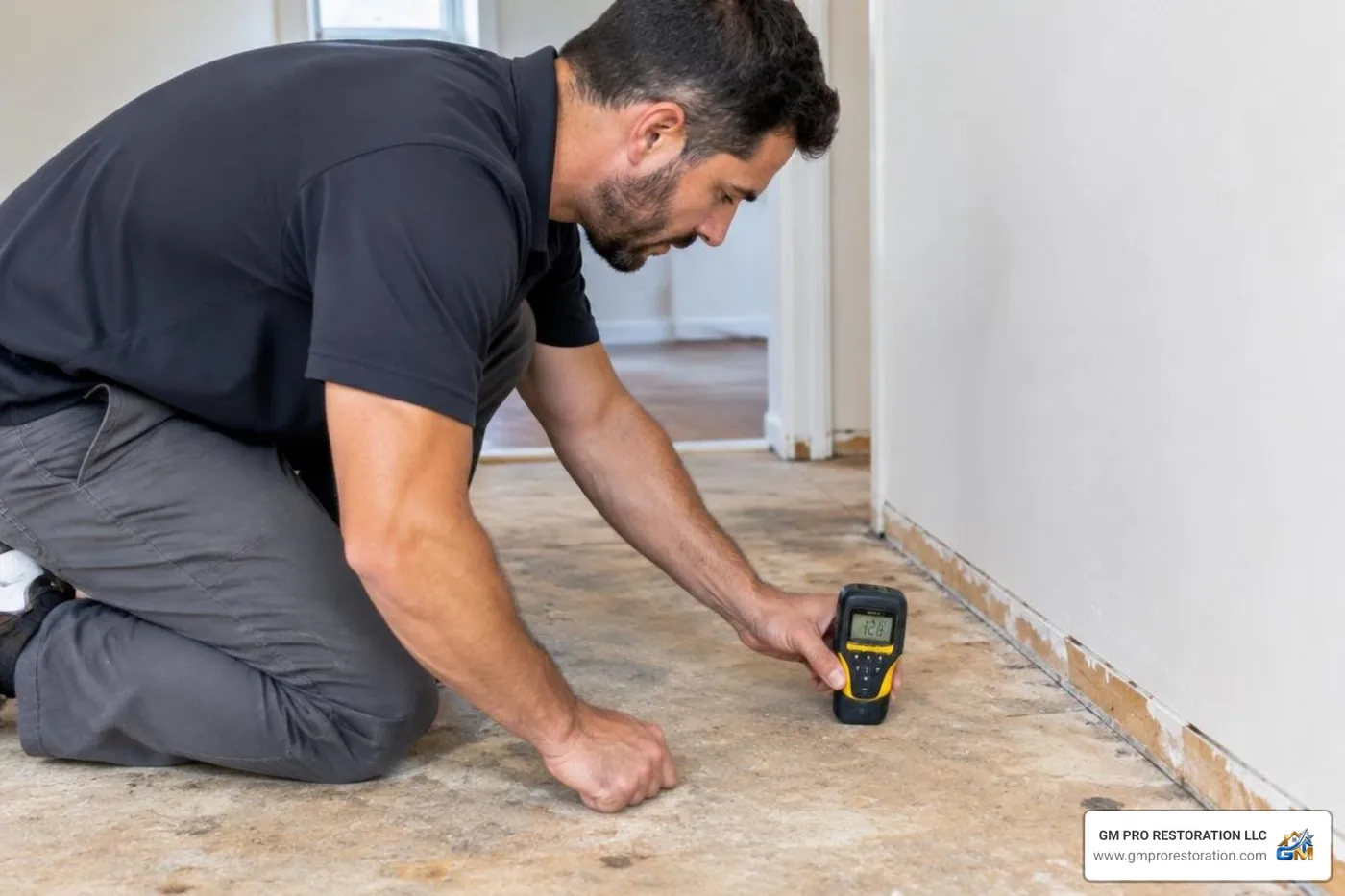
Because mold spores can germinate and colonize wet building materials within 24 to 48 hours, managing indoor temperature and humidity is essential. Our technicians establish a balanced drying environment by monitoring psychrometric values (specific humidity, dew point, and vapor pressure differential) to draw water out of thick structural timber, sill plates, and concrete foundations.
If moisture remains trapped inside enclosed wall cavities or underneath flooring assemblies, call in certified technicians for professional mold remediation. In addition, conducting a thorough mold inspection ensures that micro-reservoirs of moisture are found and treated before colonies cause structural damage or health issues.
Air Quality and Secondary Damage Control
Water damage rarely stays confined to the floor. As water evaporates into the air, relative humidity spikes throughout the home, leading to secondary damage such as peeling paint, rusted metal fixtures, warping cabinetry, and widespread spore dispersion on upper levels.
To safeguard your living environment during remediation, we implement strict engineering controls:
- Negative Air Pressure & Containment: Heavy poly-sheeting barriers isolate the flooded zone from unaffected living areas, preventing dust and microbes from migrating through HVAC ducts.
- HEPA Air Scrubbers: Commercial filtration units capture 99.97% of airborne particles down to 0.3 microns, removing mold spores, bacterial fragments, and dust.
- Environmental Assessment: Scheduling professional indoor air quality testing provides quantifiable proof that your home's air is clean, safe, and balanced.
- Verification Sampling: Comprehensive mold testing via ambient air and surface swab samples confirms that spore counts have returned to normal baseline levels before reconstruction begins.
Navigating Charlotte Waste Disposal Regulations and Insurance Claims
Properly disposing of flood-damaged building materials is critical to protecting community sanitation and staying compliant with local environmental laws.
Mecklenburg County Solid Waste management maintains clear regulations for flood debris disposal:
- Separation of Debris Streams: Building materials (drywall, subflooring, framing lumber), white goods (refrigerators, washers), and vegetative debris must not be mixed together.
- Hazardous Household Materials: Saturated paints, pool chemicals, vehicle batteries, pesticides, and appliances containing refrigerants (Freon) cannot be left on standard curbside collection routes. They must be transported to designated full-service drop-off centers, such as the Foxhole, Compost Central, or North Mecklenburg recycling facilities.
- Curbside Placement Rules: Keep bagged flood waste clear of storm drains, fire hydrants, water meters, and overhead utility lines so county collection trucks can safely operate mechanical arms.
Navigating Insurance Claims in Charlotte
Navigating an insurance claim after a storm requires clear documentation and an understanding of policy definitions.
Standard North Carolina homeowners insurance policies typically do not cover rising surface water, creek overflow, or regional flash flooding. Protection against these events requires a dedicated policy through the National Flood Insurance Program (NFIP) or a private flood insurance underwriter. Conversely, water damage originating from internal plumbing failures or sudden roof breaches caused by falling trees is generally handled under standard homeowner coverage, provided proper maintenance was upheld.
To streamline your claim process:
- Notify your insurance agent immediately to open an official claim number.
- Maintain a comprehensive, itemized proof-of-loss inventory detailing the age, condition, original cost, and estimated replacement value of all damaged items.
- Keep all discarded structural materials and high-value personal property accessible on site until your independent or staff insurance adjuster has inspected and cataloged them.
- Save every receipt and invoice from your mitigation and environmental testing team to submit for reimbursement under your policy's Additional Living Expenses (ALE) or direct mitigation clauses.
Frequently Asked Questions About Flood Damage Cleanup in Charlotte
How quickly should flood cleanup begin to prevent mold in Charlotte?
Cleanup and water extraction should start immediately, ideally within the first 24 hours. Because Charlotte experiences high ambient humidity, microbial colonization can begin on damp drywall, carpet backing, and baseboards in as little as 24 to 48 hours. Rapid deployment of commercial water extraction equipment and industrial dehumidification stops mold growth before it starts.
Does standard homeowners insurance cover flood damage in North Carolina?
No, standard homeowners policies specifically exclude damage caused by rising surface water, external flash flooding, and overflowing rivers or creeks. To protect against rising waters, homeowners must purchase a policy through the NFIP or private carriers. However, internal water damage from a ruptured water line or accidental appliance overflow is typically covered under standard property insurance.
How do I dispose of flood-damaged materials in Mecklenburg County?
Mecklenburg County requires residents to separate flood debris into distinct categories: structural construction materials, major home appliances, and hazardous chemicals. Small quantities of non-hazardous, bagged materials can often be processed through municipal bulk pickup, while large volumes and hazardous products (like paints and solvents) should be brought to county full-service drop-off centers.
Conclusion
Recovering from flood damage requires immediate action, specialized drying tools, and an understanding of local moisture risks. Overlooking hidden water pockets in subflooring, behind baseboards, or within crawl spaces can compromise your home's structural stability and degrade your indoor air quality.
At GM PRO RESTORATION LLC, we specialize in delivering honest, root-cause moisture assessments, emergency water extraction, and full-spectrum property restoration across the greater Queen City. Contact our trusted flood damage cleanup specialists in Charlotte to protect your home and restore your indoor environment safely and efficiently.