How to Get Emergency Water Damage Repair in Charlotte
Immediate Action Plan for Water Damage Repair Charlotte Homeowners Need
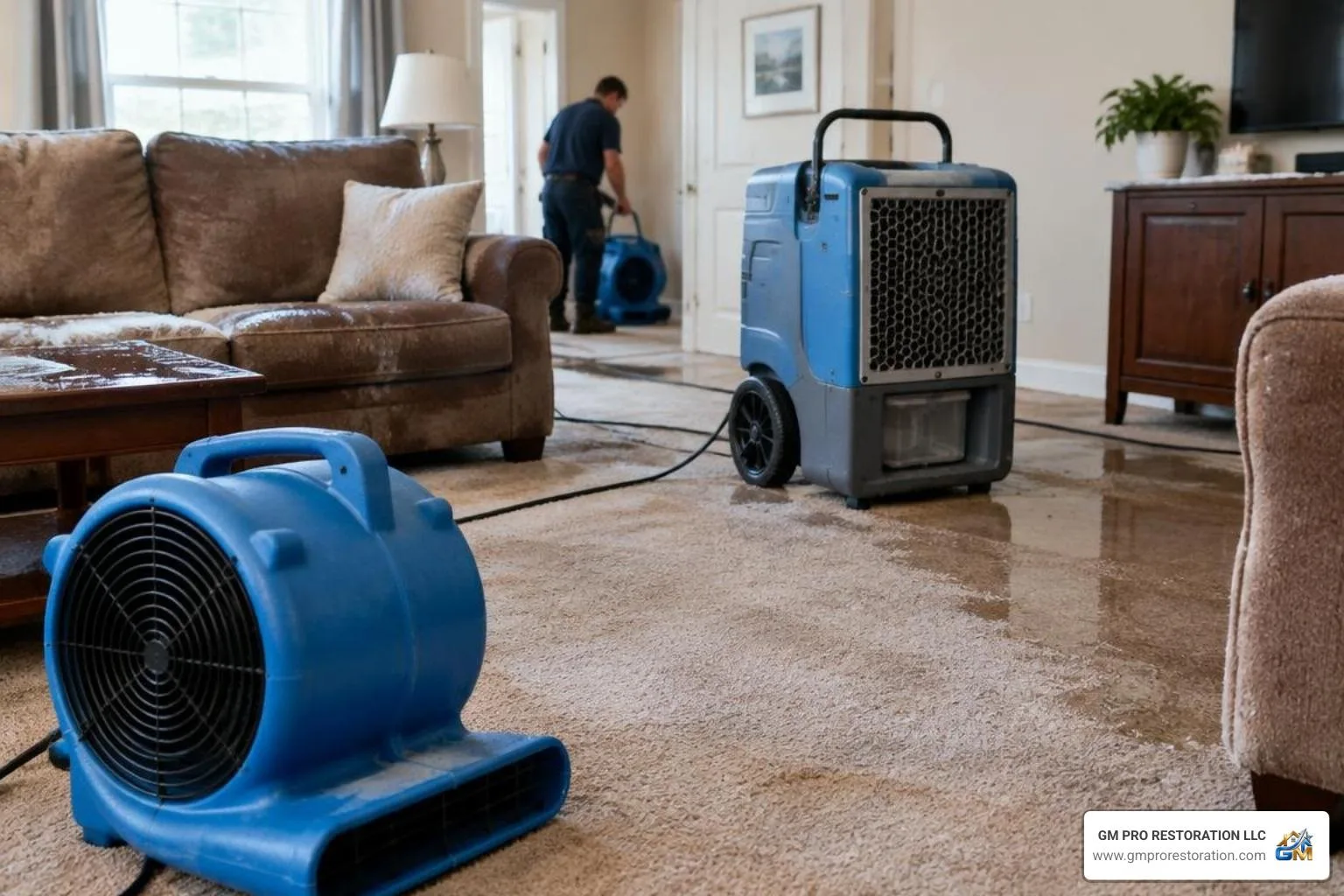
When water rushes into your living room, hallway, or crawl space, panic is natural. Water is often called the "universal solvent" because it dissolves more substances than any other liquid, and given enough time, it will dissolve adhesives, degrade drywall, rust metal fasteners, and ruin subflooring. Knowing the correct steps to take immediately after water damage keeps your family safe and dramatically reduces repair costs.
A successful emergency response balances three priorities: personal safety, property stabilization, and thorough insurance documentation. Moving quickly prevents secondary damage like microbial growth, structural rot, and electrical short circuits.
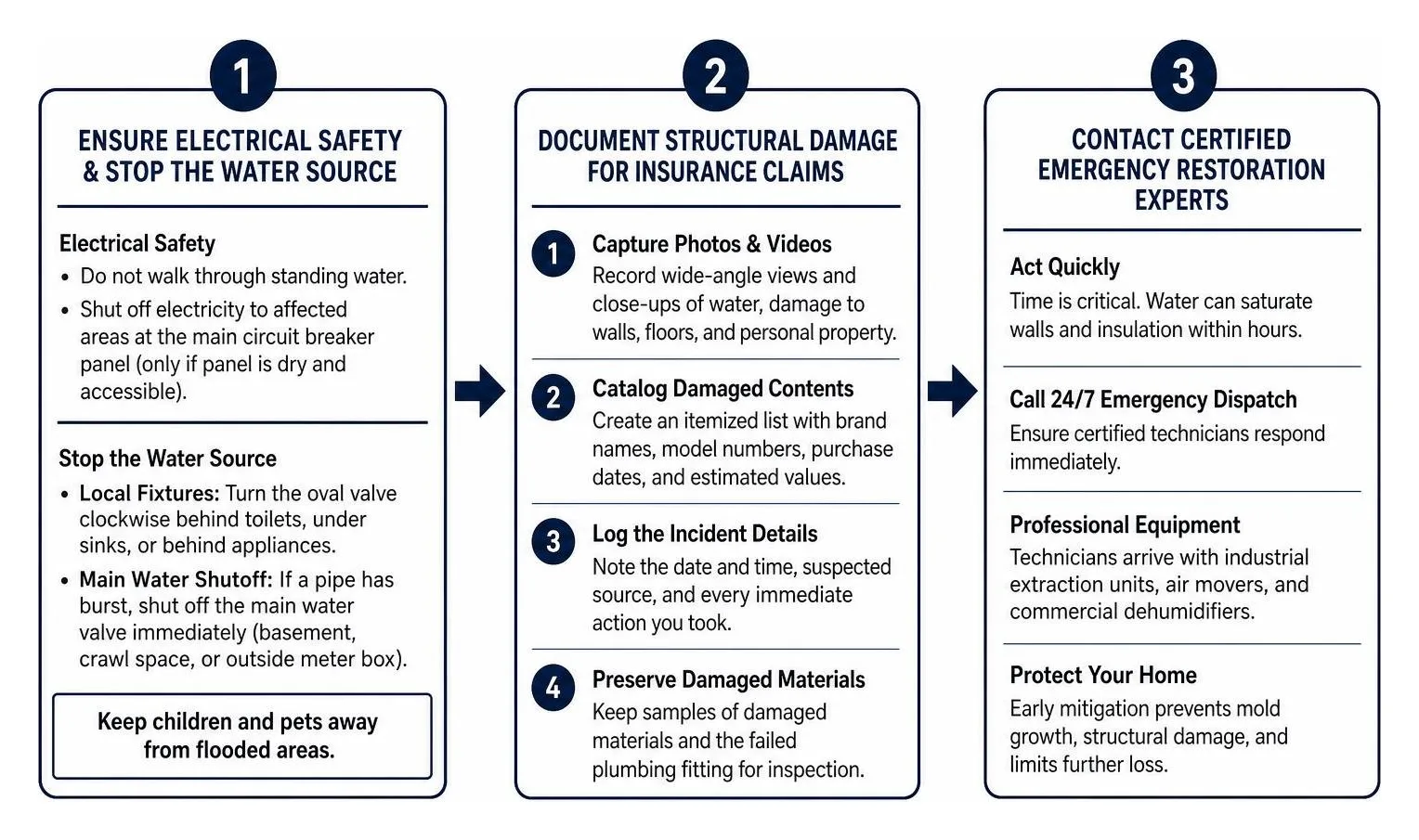
Step 1: Ensure Electrical Safety and Stop the Water Source
Before stepping into standing water, assess your electrical hazards. Water and electricity create a lethal combination. If the water level has reached wall outlets, extension cords, or major appliances, do not walk through the area. Shut off electricity to the affected zones directly at your main circuit breaker panel—provided the panel is in a dry, accessible location.
Next, shut off the water supply:
- Local Fixtures: Turn the oval valve clockwise behind a running toilet, under a leaking sink, or behind a washing machine.
- Main Water Shutoff: If a pipe has burst inside a wall or ceiling, shut off the main water valve immediately. In Charlotte homes, this valve is typically located in the basement, in the crawl space near the front foundation wall, or outside near the street in a ground meter box.
Be mindful of slip-and-fall hazards on wet hardwoods and slick tile surfaces. Keep children and pets away from flooded zones until technicians secure the area.
Step 2: Document Structural Damage for Insurance Claims
Insurance adjusters require clear, comprehensive proof of damage to process claims efficiently. Before you dispose of any soaked personal items or pull up ruined carpets, create a detailed record of the event.
- Capture High-Resolution Photos and Videos: Record wide-angle views of flooded rooms, as well as close-ups of standing water lines on baseboards, warped flooring, saturated drywall, and damaged personal property.
- Catalog Damaged Contents: Create an itemized inventory list detailing brand names, model numbers, approximate purchase dates, and estimated values of ruined items.
- Log the Incident Details: Note the exact date and time you discovered the water, the suspected source (such as an ice-maker line or severe thunderstorm), and every immediate action you took to stop the flow.
- Preserve Damaged Materials: Keep samples of damaged materials (such as a section of ruined flooring or the failed plumbing fitting) so the insurance adjuster can inspect the root cause.
Step 3: Contact Certified Emergency Restoration Experts
Time is your biggest adversary during a water intrusion event. Water wicks up porous drywall at an alarming rate through capillary action, saturating wall framing and insulation within hours. Contacting a 24/7 emergency dispatch team ensures certified technicians arrive with industrial extraction units, heavy-duty air movers, and commercial desiccant or LGR dehumidifiers.
Early professional mitigation stabilizes the building envelope, prevents structural shifting, creates containment barriers around wet areas, and protects unaffected rooms from elevated indoor humidity.
Evaluating Water Categories and Structural Vulnerabilities in Charlotte
Water damage is not one-size-fits-all. The Institute of Inspection, Cleaning and Restoration Certification (IICRC) establishes rigorous industry standards (specifically the IICRC S500) classifying water intrusions into three distinct categories based on contamination levels. Understanding these categories dictates the protective gear, sanitization protocols, and disposal procedures needed for your home.
| Water Damage Category | Description & Common Sources | Health Risk Level | Typical Remediation Protocol |
|---|---|---|---|
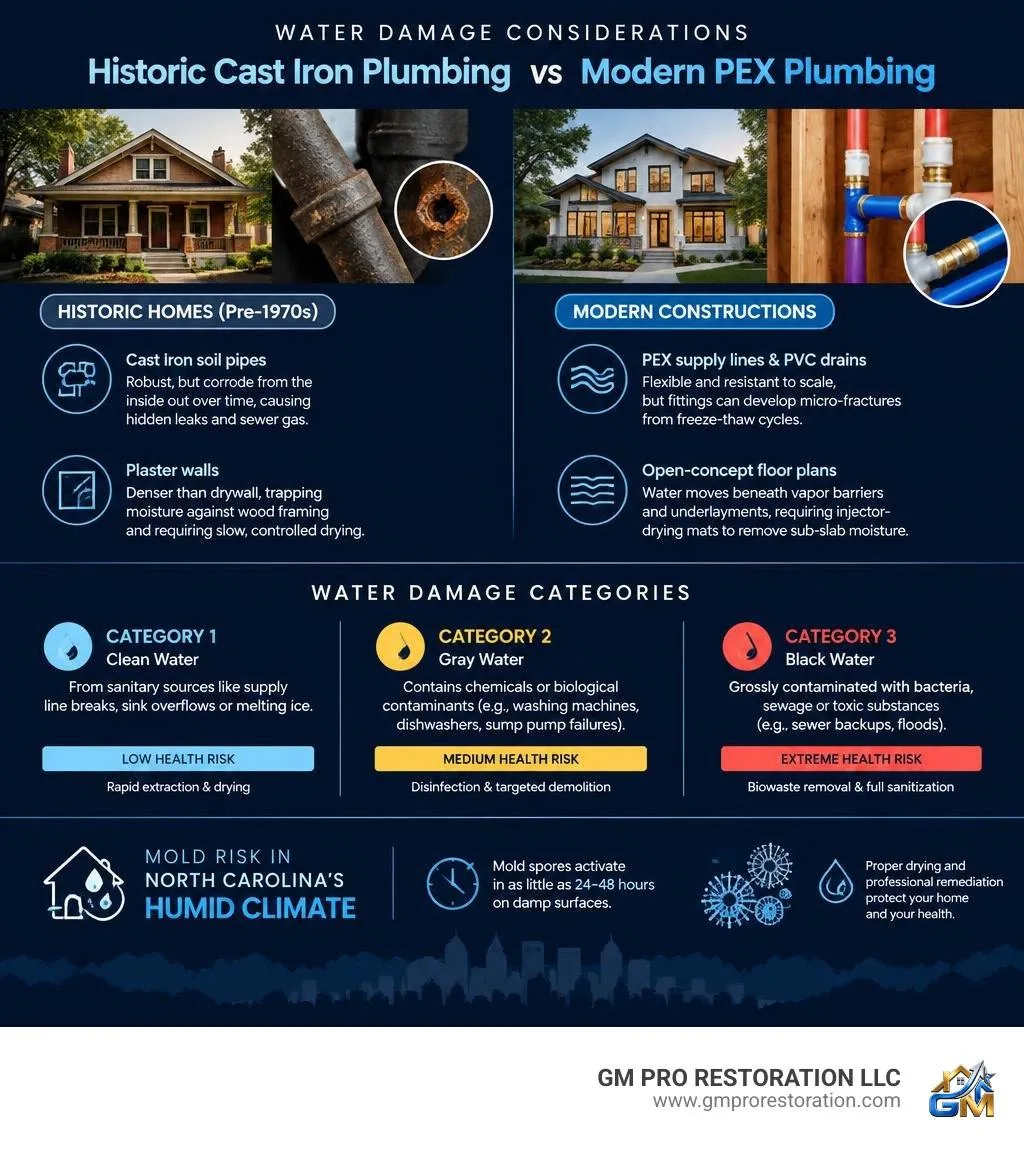
| Category 1: Clean Water | Originates from sanitary sources like broken supply lines, sink overflows without contaminants, or melting ice. | Low (if addressed within 24–48 hours) | Rapid extraction, structural drying, non-invasive dehumidification, minimal teardown. |
| Category 2: Gray Water | Contains significant chemical, biological, or physical contamination. Sources include washing machine discharges, dishwasher overflows, or sump pump failures. | Medium (can cause discomfort or illness upon contact) | Contaminated carpet pad removal, aggressive disinfection, targeted demolition of porous materials, specialized structural drying. |
| Category 3: Black Water | Grossly contaminated with pathogenic agents, bacteria, sewage, or toxic substances. Sources include sewer backups, rising river/flash flood water, and standing water. | Extreme (severe health hazard upon contact or inhalation) | Complete biowaste extraction, mandatory removal of porous building assemblies, emergency sewage backup cleanup, microbial sanitization. |
Identifying Water Types from Clean to Category 3 Black Water
A clean Category 1 water spill can degrade into Category 2 gray water in fewer than 48 hours as it dissolves dirt, finishes, and building chemicals. If left unmitigated, it deteriorates into Category 3 black water within days as bacteria and microbes proliferate in Charlotte's warm ambient indoor air.
Category 3 black water scenarios require rigorous biohazard containment. Technicians must wear specialized Personal Protective Equipment (PPE), establish negative air pressure machines with HEPA filtration, and safely dispose of contaminated, porous structural elements to safeguard your family's health.
Water Damage Repair Charlotte Considerations for Historic vs Modern Homes
Charlotte's diverse architectural landscape spans historic bungalows in Dilworth and Fourth Ward to modern developments across South End, Ballantyne, and University City. Restoring water damage varies significantly between these construction eras:
- Historic Homes (Pre-1970s): Older properties often feature heavy cast iron soil pipes for drainage. While cast iron is robust and does not require the specialized bedding that flexible plastic pipes demand, these pipes corrode from the inside out over several decades. This causes unseen hairline cracks, sewer gas leaks, and hidden crawl space saturation. Historic properties also feature plaster walls, which are denser than drywall and trap moisture against structural wood studs, requiring slow, controlled heat and cavity drying techniques.
- Modern Constructions: Newer residences typically feature PEX supply lines and PVC drainage systems. While flexible and resistant to scale, PEX fittings can experience micro-fractures if exposed to sudden winter freeze-thaw cycles. Modern open-concept floor plans with engineered hardwoods over concrete slabs present different challenges: water quickly migrates beneath vapor barriers and underlayments, requiring specialized injector-drying mats to draw out sub-slab moisture without tearing up entire floors.
Mold Risk and Microbial Growth in North Carolina's Humid Climate
Charlotte's humid subtropical climate features hot, moisture-laden summers and frequent precipitation. Because ambient outdoor humidity frequently exceeds 70%, building envelopes in the Queen City are naturally prone to dampness.
When an indoor water loss occurs, dormant mold spores activate in as little as 24 to 48 hours on damp cellulose surfaces such as drywall paper, wood framing, and baseboard backing. Water's unique molecular structure and hydrogen bonding allow it to cling tenaciously to porous building materials. If structural drying is delayed or handled with basic household fans, indoor fungal amplification is practically guaranteed. Implementing comprehensive mold remediation protocols cleans the air and returns your indoor environment to safe, pre-loss conditions.
Step-by-Step Professional Drying and Property Restoration
Restoring a water-damaged building is a precise science known as psychrometrics—the study of thermodynamic properties of moist air. We use specialized equipment, scientific calculations, and precise moisture monitoring to restore structural components to their dry standard.
Water Extraction and Advanced Moisture Detection
Mitigation begins by eliminating liquid water as quickly as possible. Removing liquid water with extractors is roughly 1,200 times faster than removing it via evaporation.
Our technicians deploy commercial submersible pumps for deep basement flooding, paired with weighted, truck-mounted extraction units to pull water directly from carpets, pads, and hard flooring surfaces.
Once standing water is removed, non-invasive diagnostic tools map the full extent of hidden moisture migration:
- Infrared Thermal Cameras: Detect subtle temperature differentials caused by evaporative cooling, pinpointing moisture hidden behind sheetrock, beneath tiled showers, or inside insulation.
- Pin-Type and Pinless Moisture Meters: Measure the exact moisture percentage inside wood studs, concrete subfloors, and drywall.
- Thermo-Hygrometers: Measure the ambient air temperature, relative humidity, and dew point inside affected rooms versus unaffected baseline zones.
Through systematic testing, our professional water damage restoration specialists ensure no pockets of hidden saturation are left behind to deteriorate structural framing.
Structural Dehumidification and Antimicrobial Treatment
Once liquid water is extracted, moisture remaining inside building materials must be drawn out through balanced evaporation and dehumidification:
- High-Velocity Air Movers: Positioned strategically along walls and floors to sweep away the cool, boundary layer of saturated air clinging to wet surfaces, accelerating the evaporation rate.
- Low-Grain Refrigerant (LGR) Dehumidifiers: Pull moisture-laden air across ultra-cold coils to condense water out of the air, discharging warm, bone-dry air back into the room to absorb more moisture from structural lumber.
- Antimicrobial Applications: EPA-registered, botanical, or hospital-grade antimicrobials are applied to damp framing, sill plates, and subfloors to neutralize bacterial growth, suppress mold spores, and eliminate musty odors.
Technicians maintain daily moisture logs, tracking psychrometric dry-down curves until every structural element reaches its baseline equilibrium moisture content (EMC).
Long-Term Prevention for Crawl Spaces and Basements
Once emergency restoration is complete, protecting your home against recurring water damage is paramount—especially in Charlotte, where crawl space and basement construction is prevalent.
- Encapsulate Crawl Spaces: Seal dirt crawl spaces with heavy 12-to-20-mil vapor barriers across the earth and foundation walls. Combine this with a dedicated crawl space dehumidifier to maintain humidity levels below 55%.
- Maintain Foundation Drainage: Clean gutter systems regularly and extend downspout discharge pipes at least 6 to 10 feet away from the foundation footing.
- Install Sump Pumps with Battery Backups: Equip basements with dual-pump systems featuring a marine-grade battery backup to protect your basement during severe weather power outages.
- Winterize Plumbing: Water expands by roughly 9% when it freezes, exerting immense pressure that easily ruptures exposed copper or plastic pipes. Insulate exterior spigots, disconnect garden hoses in late autumn, and keep crawl space vents closed during hard winter freezes.
Frequently Asked Questions About Charlotte Water Damage
What are the average costs of water damage repair Charlotte property owners face?
Water damage restoration costs depend on the square footage of the affected area, the category of water (clean vs. sewage), structural materials involved, and whether tear-out and reconstruction are required. A minor clean-water supply line leak caught immediately may cost between $1,500 and $3,500 for drying and sanitization.
Conversely, a major Category 3 black water sewer backup or second-story pipe rupture that saturates multiple levels can range from $5,000 to over $15,000, including reconstruction of drywall, trim, and flooring. Standard homeowner insurance policies generally cover sudden and accidental water discharges (such as a burst pipe or water heater failure), while gradual damage, neglected maintenance, or external rising floodwaters require separate flood insurance coverage.
How quickly does mold begin growing after water damage in Charlotte?
In Charlotte's warm, humid climate, mold spores germinate and begin colonizing damp building materials within 24 to 48 hours following a water intrusion. Drywall paper, plywood subflooring, and carpet backing provide an ideal organic food source for fungi when moisture levels remain elevated. Fast professional water extraction and industrial drying are critical to halt spore germination before mold spreads.
How do I select a qualified water damage restoration contractor?
When selecting a restoration contractor in the Charlotte area, verify the following credentials:
- IICRC Certification: Ensure technicians hold credentials in Water Damage Restoration (WRT) and Applied Structural Drying (ASD).
- 24/7 Rapid Emergency Response: Water damage worsens by the hour; your restoration partner should be ready to deploy immediately.
- Direct Insurance Coordination: Look for contractors who utilize industry-standard estimating software (like Xactimate) and work directly with your insurance adjuster.
- Honest, Root-Cause Diagnostic Assessments: Choose a team focused on identifying and addressing the root cause of the leak rather than performing cosmetic cover-ups.
Conclusion
A water emergency in your home or business demands swift, decisive mitigation to protect your structural investments, air quality, and peace of mind. Whether dealing with an overflowing appliance, a burst frozen line, or heavy storm flooding, waiting to address damp materials increases the risk of wood rot, subfloor warping, and hazardous mold growth.
At GM PRO RESTORATION LLC, our certified technicians provide transparent, root-cause assessments, rapid structural drying, and comprehensive mitigation across the region. If you are experiencing an active leak or discovering hidden moisture damage, contact our certified Charlotte NC water damage repair services team today for 24/7 emergency response and expert restoration care.