
Finding the Best Indoor Air Monitor to Protect Your Family
Why an Air Monitor Is Worth Having
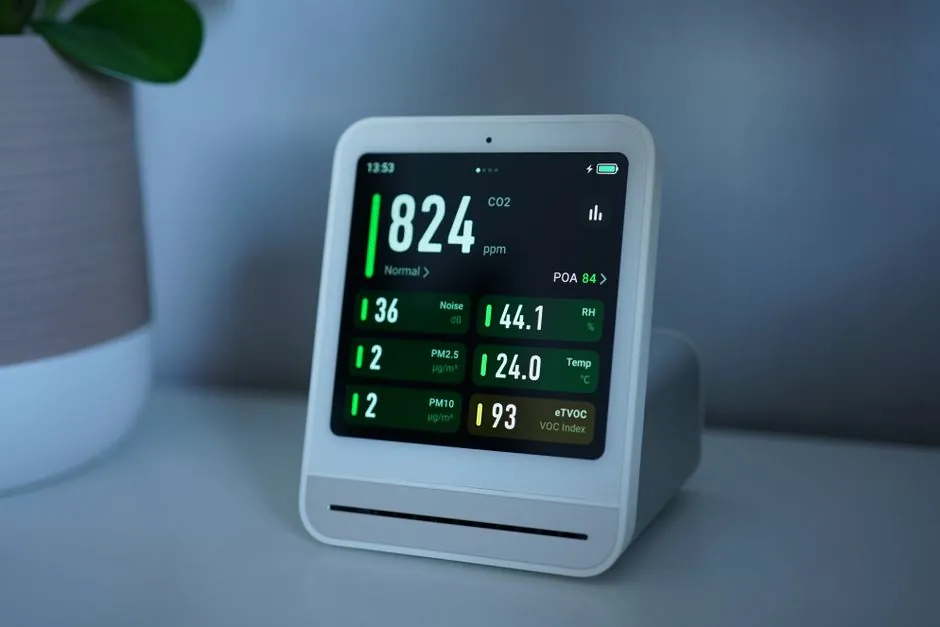
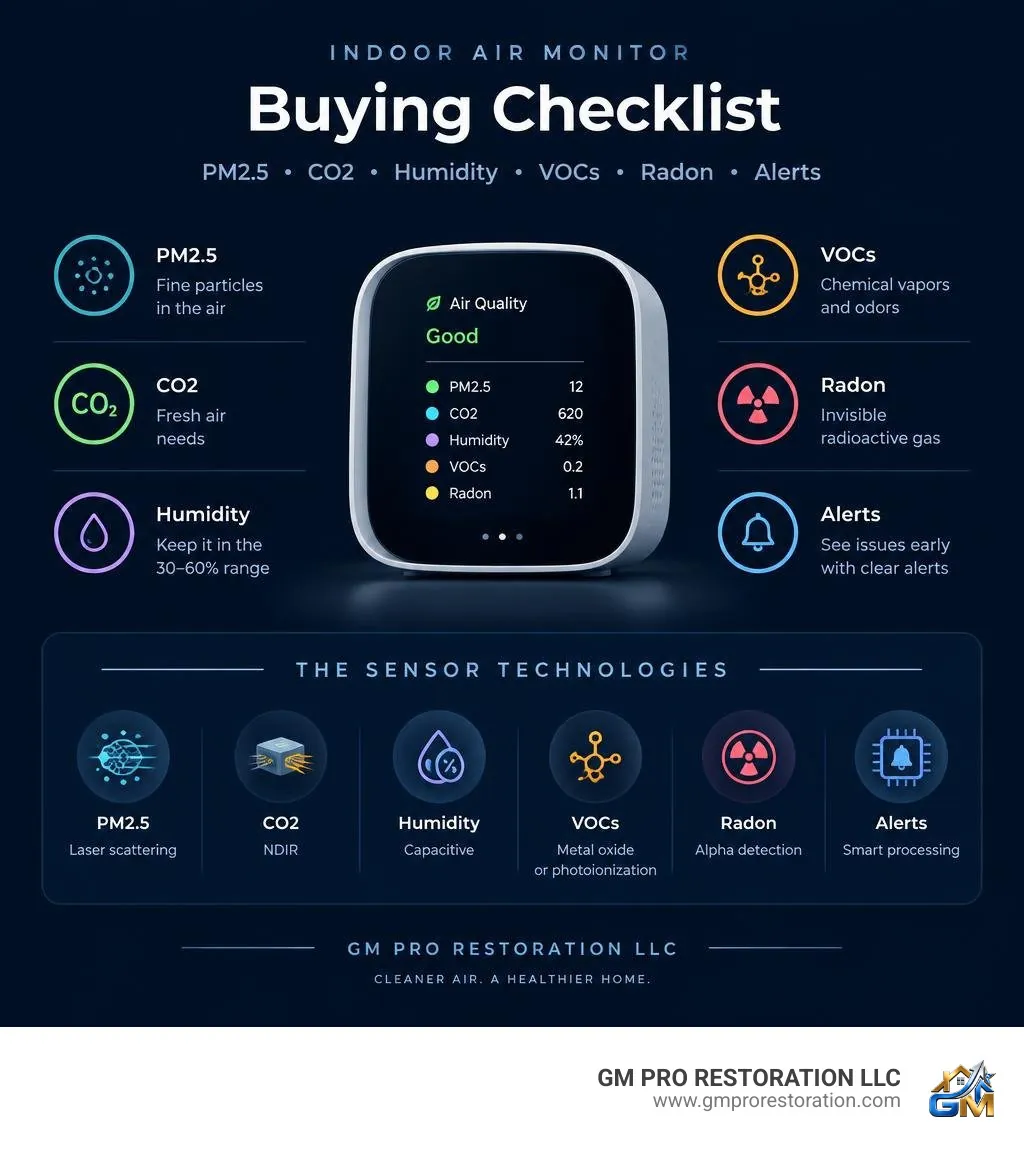
The best indoor air monitor is one that measures the risks most relevant to your home: fine particle pollution (PM2.5), carbon dioxide (CO2), humidity, and volatile organic compounds (VOCs). If you live with water damage, musty odors, recent repairs, or wildfire smoke, consider a model that also tracks radon and keeps a clear history of readings.
Look for these essentials:
- PM2.5 sensor to spot smoke, cooking particles, dust, and other fine pollution.
- NDIR CO2 sensor to show when a room needs more fresh-air ventilation.
- Humidity tracking to help keep indoor moisture in the 30% to 60% range, which can limit mold-friendly conditions.
- VOC monitoring to flag chemical vapors from paint, new flooring, cleaners, and furnishings.
- A readable display, alerts, and trend data so you can see whether a problem is a short spike or an ongoing issue.
An air monitor cannot identify mold species or replace professional testing after significant water damage. But it can reveal patterns worth acting on, such as humidity that stays high, particles that surge when the HVAC starts, or VOC levels that rise after renovation work.
Essential Features and Sensor Technologies in Modern Air Monitors
When shopping for an air quality monitor, understanding the hardware inside the enclosure makes all the difference between a reliable diagnostic tool and an expensive paperweight. Indoor air contains microscopic particles, gases, and radioactive elements, each requiring distinct detection methods.
How Different Sensors Detect Contaminants
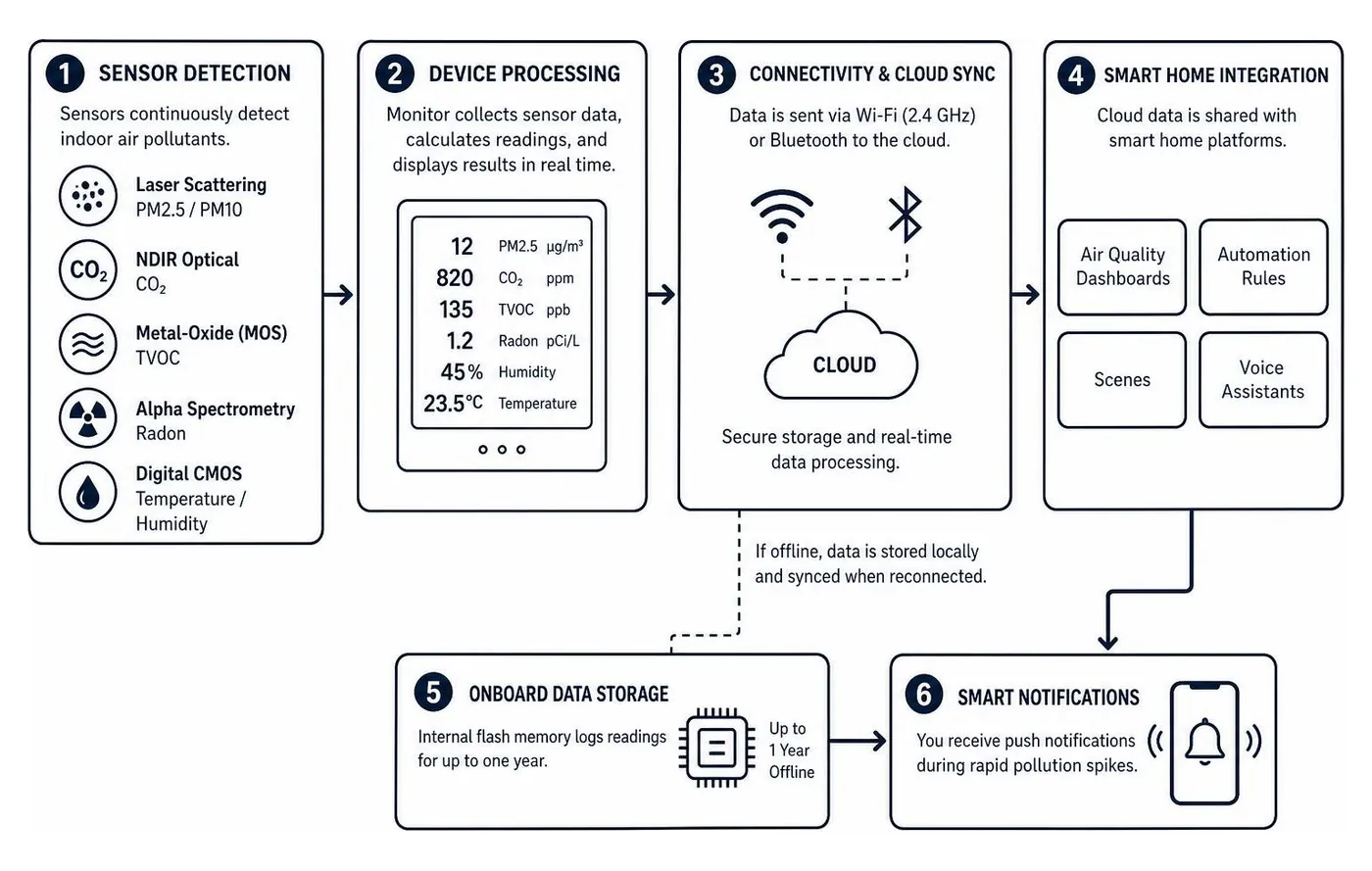
- Optical Particle Counters (Laser Scattering): These sensors detect fine particulate matter, most notably PM2.5 (particles 2.5 microns or smaller) and PM10. A miniature laser illuminates incoming air drawn into the chamber by a tiny internal fan. As airborne particles pass through the laser beam, they scatter light across a photodiode collector. The sensor calculates the concentration in micrograms per cubic meter (µg/m³) by measuring the intensity and frequency of these light pulses.
- Non-Dispersive Infrared (NDIR) CO2 Sensors: True carbon dioxide measurement requires an NDIR sensor. This component uses an infrared lamp and an optical filter to direct a specific wavelength of infrared light (around 4.26 microns) through a gas sample tube. Because CO2 molecules absorb this exact wavelength, the amount of light reaching the detector decreases proportionally as CO2 concentration climbs. Budget monitors sometimes calculate "estimated CO2" (eCO2) based on general volatile gas readings, but true NDIR sensing is necessary for reliable ventilation tracking.
- Metal-Oxide Semiconductor (MOS) TVOC Sensors: Total Volatile Organic Compounds (TVOCs) encompass thousands of carbon-based chemicals, including formaldehyde, benzene, and aerosol propellants. Metal-oxide sensors heat a tiny chemical sensing film. When ambient VOC gases pass over this heated surface, a redox reaction alters the electrical resistance of the material. The monitor converts this electrical shift into a parts-per-billion (ppb) or parts-per-million (ppm) reading.
- Alpha Spectrometry for Radon Detection: Radon is an odorless, invisible, radioactive gas that seeps from bedrock into living spaces. Continuous radon monitors use a passive diffusion chamber equipped with silicon photodiodes. When radon gas enters the chamber and decays, it emits alpha particles. The sensor measures the energy levels of these alpha strikes, converting the count into picocuries per liter of air (pCi/L) or becquerels per cubic meter (Bq/m³).
- Capacitive Relative Humidity and Temperature Sensors: Digital CMOS sensors monitor indoor comfort and moisture by tracking changes in electrical capacitance across a polymer dielectric layer as ambient water vapor shifts.
| Sensor Type | Target Pollutant | Typical Measurement Range | Manufacturer Stated Precision | Average Lifespan |
|---|---|---|---|---|
| Laser Scattering | PM2.5 / PM10 Particles | 0–1,000 µg/m³ | ± 10 µg/m³ or ± 10% | 3–5 Years |
| NDIR Optical | Carbon Dioxide (CO2) | 400–10,000 ppm | ± 30 to 75 ppm or ± 3% | 10–15 Years |
| Metal-Oxide (MOS) | TVOC Chemical Vapors | 0–60,000 ppb | Relative Trend (± 10–15%) | 3–5 Years |
| Alpha Spectrometry | Radon Gas | 0–500 pCi/L | ± 10% after 7 days | 7–10 Years |
| Digital CMOS | Relative Humidity | 0–100% RH | ± 2–3% RH | 5–10 Years |
Connectivity and Onboard Data Storage
Modern air monitors communicate via 2.4 GHz Wi-Fi and Bluetooth. Direct cloud syncing allows you to receive push notifications during rapid pollution spikes, such as cooking flare-ups or sudden smoke intrusion.
Onboard data logging provides continuous coverage during network interruptions. High-quality monitors feature internal flash memory capable of logging sensor readings for up to a full year offline, synchronizing the historical timeline as soon as the home Wi-Fi network reconnects.
Top Contenders for the Best Indoor Air Monitor in 2026
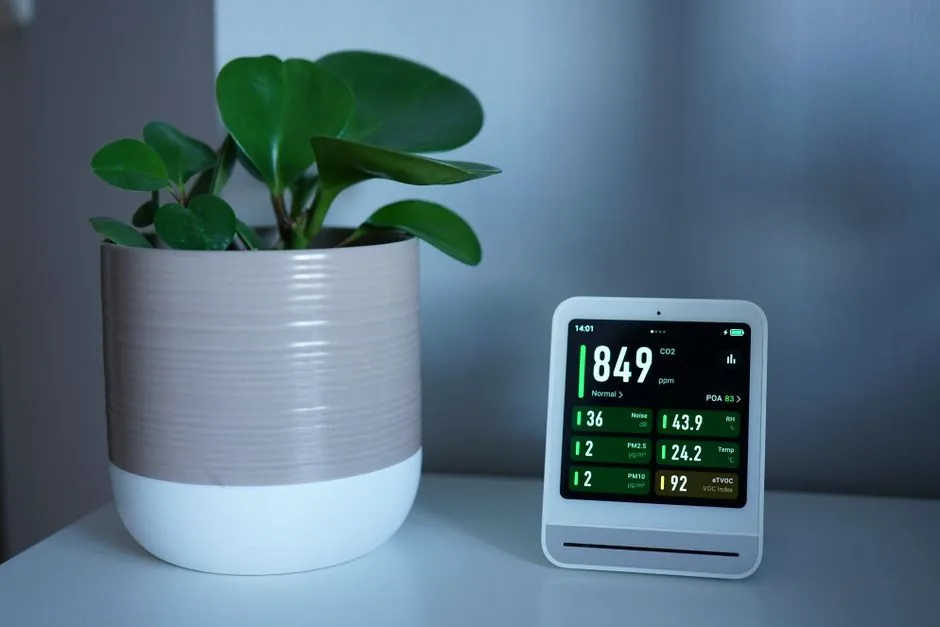
Evaluating consumer air quality hardware requires balancing sensor accuracy, reporting speed, screen legibility, and long-term operating costs. Below, we compare the top-performing monitors on the market across distinct consumer categories.
For Multi-Pollutant and Radon Tracking: Airthings View Plus
For whole-home protection that covers both everyday comfort and serious environmental health hazards, the Airthings View Plus smart radon and air quality monitor stands out as an industry leader.
Unlike standard consumer monitors that restrict their tracking to particulate dust and humidity, the View Plus integrates an alpha spectrometry radon sensor alongside PM2.5, CO2, TVOC, temperature, humidity, and barometric pressure sensors. The Environmental Protection Agency (EPA) notes that radon is the leading cause of lung cancer among non-smokers, establishing an action threshold of 4.0 pCi/L. Because radon concentrations fluctuate dramatically with outdoor soil pressure and seasonal heating cycles, continuous monitoring is far more protective than a single short-term charcoal test kit.
The device features a customizable, low-power E-ink display that remains visible in direct sunlight without producing nocturnal room glare. Powered by either six AA batteries (offering up to two years of continuous operation) or an included USB-C cable, the View Plus can also function as a wireless smart hub, bridging other Bluetooth-enabled peripheral monitors directly to your Wi-Fi network. It integrates smoothly with Amazon Alexa, Google Assistant, and IFTTT, allowing homeowners to set up automated routines—such as turning on a heat recovery ventilator (HRV) or whole-house exhaust fan when CO2 levels exceed 1,000 ppm.
For Particles and Chemical Vapors: Three Focused Alternatives
If your main concerns involve seasonal wildfire smoke, cooking aerosols, cleaning off-gassing, or office ventilation, several focused alternatives deliver exceptional performance:
- AirVisual Pro Indoor Monitor: This unit is engineered around precision dual laser-scattering particle sensors and a dedicated NDIR CO2 module. It features a bright, 5-inch color LCD display that shows real-time indoor air metrics directly alongside live, hyper-local outdoor air quality index (AQI) forecasts. This side-by-side view helps users determine whether opening a window will refresh the home or draw in fine outdoor dust and pollen. With offline data logging and high-accuracy particulate calibration, it remains an exceptional choice for severe allergy sufferers.
- Awair Element indoor air monitor: Built with an eye-catching mid-century style, the Awair Element measures five parameters: PM2.5, TVOCs, CO2, temperature, and relative humidity. Its front-facing, dimmable LED matrix provides an intuitive, glanceable 0–100 indoor air quality score. The companion app offers personalized feedback, explaining whether a spike stems from cooking emissions, household cleaning products, or insufficient room airflow.
- Temtop M10+ WiFi monitor: An affordable, portable unit combining an E-ink display with a rechargeable 2200 mAh lithium-ion battery. The M10+ tracks PM2.5, TVOCs, CO2, AQI, temperature, and humidity. Its adaptive sampling software conserves battery life while tracking background air quality trends, making it well-suited for spot-checking home offices, classrooms, and bedrooms.
How to Interpret Air Quality Readings and Take Action
Tracking your home's air quality is only helpful if you know how to respond when numbers move outside safe baseline ranges.
Fine Particulate Matter (PM2.5)
- Target Baseline: Below 10 to 12 µg/m³
- Elevated Range: 35 to 55 µg/m³ (Unhealthy for sensitive groups)
- Dangerous Spikes: >55 µg/m³
- Action Plan: When indoor PM2.5 surges due to cooking or smoke infiltration, run your range hood, verify windows are sealed, and run high-efficiency particulate air filtration. Upgrading central HVAC filters to a MERV 13 rating helps pull fine particles out of circulation quickly.
Carbon Dioxide (CO2)
- Target Baseline: 400 to 800 ppm
- Cognitive Decline Threshold: 1,000 to 1,500 ppm
- Lethargy and Stagnation: >2,000 ppm
- Action Plan: Elevated CO2 is a direct indicator of insufficient outdoor air exchange. In closed bedrooms or sealed home offices, human respiration quickly drives CO2 past 1,200 ppm, leading to morning headaches, brain fog, and poor sleep. When numbers climb, crack a window, turn on mechanical ventilation, or switch your HVAC fan to continuous mode.
Volatile Organic Compounds (TVOCs)
- Target Baseline: Below 220 to 300 ppb
- Moderate Exposure: 300 to 1,000 ppb
- High Risk: >1,000 ppb
- Action Plan: VOC spikes typically trace back to aerosol sprays, synthetic fragrances, cleaning solvents, new carpets, or fresh paint. Increase fresh-air ventilation to purge off-gassing vapors, and consider air purification systems equipped with dense activated carbon beds.
Relative Humidity
- Optimal Safe Range: 30% to 50% (Never exceed 60%)
- Action Plan: Sustained indoor relative humidity above 60% creates prime conditions for microbial colonization and dust mite proliferation. Run dedicated dehumidifiers in basements, inspect plumbing fixtures for hidden leaks, and run bathroom exhaust fans during and after showers.
Placement, Maintenance, and Calibration Best Practices
An indoor air monitor is only as dependable as its environment allows. Poor placement or uncalibrated sensors lead to skewed readings and false alarms.
Optimal Monitor Placement
- Breathing Zone Elevation: Set the monitor between three and six feet above the finished floor, approximating the height where family members breathe while sleeping or sitting.
- Avoid Drafts and Dead Zones: Keep the unit at least three feet away from exterior entry doors, forced-air supply vents, window sills, and portable fan streams. Fast drafts bypass sensor diffusion chambers and produce artificial readouts.
- Avoid High-Steam Areas: Never place an indoor monitor directly beside a stove, over an electric kettle, or inside a high-humidity bathroom. Direct steam condensation can damage optical particle chambers and metal-oxide plates.
- Central Living Areas: Place your primary monitor in the bedroom or main family living room where household members spend the majority of their time.
Maintenance and Sensor Care
- Clear the Intake Ports: Every two to three months, gently vacuum the sensor intake grilles with a soft brush attachment or use a can of dry compressed air held 12 inches away to dislodge accumulated lint.
- Manage Automatic Baseline Calibration (ABC): Many NDIR CO2 sensors rely on automated background calibration, assuming the sensor is exposed to fresh outdoor baseline air (roughly 400–420 ppm CO2) once every week. If your monitor is stationed in an occupied, tightly sealed room that never reaches fresh-air levels, the baseline can drift downward. Open all windows for 20 minutes once a week to reset the baseline accurately.
- Account for Sensor Drift: Electrochemical and metal-oxide sensors naturally degrade over time through chemical saturation. Plan to replace consumer monitoring devices or their modular sensor cartridges every three to five years to maintain dependable baseline accuracy.
Frequently Asked Questions About Indoor Air Monitors
How accurate are consumer indoor air monitors compared to professional testing?
Consumer monitors provide useful screening data, real-time trend detection, and immediate pollution spike alerts. However, they use low-voltage laser diodes and broad-spectrum metal-oxide sensors rather than laboratory-calibrated photoionization detectors (PID), gas chromatography, or gravimetric samplers.
A consumer monitor will tell you that total VOCs are rising, but it cannot differentiate harmless cooking aromas from carcinogenic benzene or toxic formaldehyde. Similarly, an optical monitor tracks general fine particle mass, but it cannot identify whether airborne particles are harmless kitchen flour, toxic soot, or living mold spores.
How often do indoor air monitor sensors need to be replaced or calibrated?
Sensor lifespans vary by detection technology:
- NDIR CO2 sensors: Function reliably for 10 to 15 years with minimal maintenance beyond routine fresh-air baseline exposure.
- Optical PM2.5 laser sensors: Last 3 to 5 years under typical household use before fan motors wear down or internal optical mirrors collect dust.
- TVOC sensors: Experience baseline drift within 2 to 4 years due to surface degradation of the metal-oxide film.
- Radon detectors: Alpha-counting silicon photodiodes maintain consistent calibration for 7 to 10 years.
Where is the best place to set up an indoor air monitor in a home?
The best location is in the room where your family spends the most consecutive hours—typically the primary bedroom or main living room. Position the unit at breathing height on a nightstand, shelf, or side table, ensuring it sits at least three feet away from HVAC vents, oscillating fans, open windows, and humidifiers. For multi-story homes, consider keeping one monitor in the basement or ground floor (for radon and humidity monitoring) and a second unit in the upstairs sleeping quarters (for CO2 and particle tracking).
Conclusion
A high-performance indoor air quality monitor gives you continuous visibility into the invisible atmosphere of your home. Tracking particulate matter, chemical vapors, carbon dioxide, humidity, and radon provides the insights needed to protect respiratory health and maintain a comfortable living space.
However, consumer air monitors are early-warning screening tools, not complete diagnostic solutions. If your monitor consistently reports elevated relative humidity, recurring particulate spikes, or unexplained chemical vapor levels—or if your family is dealing with musty odors, unexplained allergy symptoms, or the aftermath of hidden water intrusion—hardware sensors alone cannot solve the underlying issue.
At GM PRO RESTORATION LLC, we provide honest, root-cause assessments across the greater Charlotte region. When you need clear, laboratory-backed answers and dependable environmental remediation, schedule professional indoor air quality testing in Charlotte NC to identify hidden hazards, resolve moisture problems, and ensure your home's air remains clean and safe.