
What Homeowners Should Expect to Pay for a Mold Air Quality Test
What Determines the Price of a Mold Air Test in 2026?
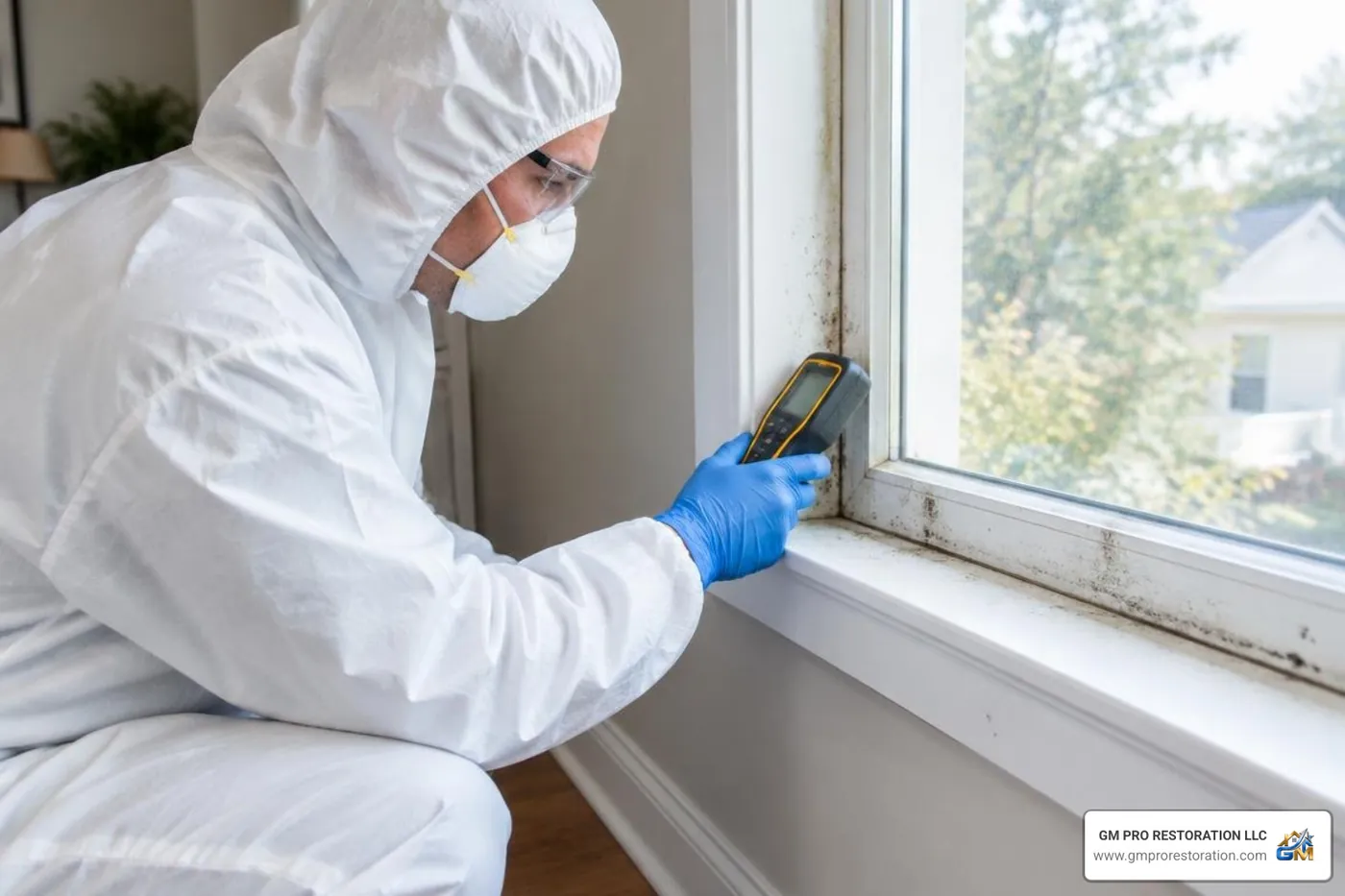
When you request an estimate for indoor air testing, inspectors do not simply pull a number out of thin air. Instead, pricing reflects the time spent on-site, the equipment used, and the third-party laboratory fees required to analyze your samples. Nationally, residential testing projects range from $300 to $900+, with the average single-family home cost landing around $400 to $650.
Understanding how different variables influence your final quote helps you avoid surprise charges and ensure you receive a thorough diagnostic evaluation. The Environmental Protection Agency notes that indoor mold growth should be addressed promptly and that testing is most useful when paired with a visual inspection and moisture assessment.
- Square footage and home layout: Larger homes naturally require more time to assess and more air samples to achieve meaningful coverage. A 1,200-square-foot ranch home might require only three samples, whereas a 4,500-square-foot property with multiple HVAC zones, a finished basement, and an attic might require six to eight samples.
- Sample volume: Every air cassette or surface swab collected must be logged onto a chain-of-custody form, shipped, and manually evaluated under a microscope by an accredited mycologist. More samples directly correlate to higher laboratory and administrative fees.
- Geographic pricing and climate: Regional labor rates and environmental conditions impact pricing. Humid coastal or southeastern markets often see slightly higher baseline pricing compared to dry inland regions due to higher equipment wear, specialized local licensing requirements, and heavy seasonal demand.
- Laboratory accreditation: Reputable assessment firms partner exclusively with laboratories accredited by the American Industrial Hygiene Association (AIHA) or Environmental Microbiology Laboratory Accreditation Program (EMLAP). These certified labs charge higher per-sample processing rates than unaccredited facilities, but they provide legally defensible, highly accurate data.
| Property Size (Sq. Ft.) | Typical Air Sample Count | Average Total Cost Range (2026) | Best Suited For |
|---|---|---|---|
| Under 1,500 | 2–3 Samples (1 outdoor + 1–2 indoor) | $350 – $500 | Small apartments, condos, or single-room checks |
| 1,500 – 2,500 | 3–4 Samples (1 outdoor + 2–3 indoor) | $450 – $650 | Standard single-family homes, single HVAC zone |
| 2,500 – 4,000 | 4–6 Samples (1 outdoor + 3–5 indoor) | $600 – $950 | Multi-story homes, dual HVAC systems, basements |
| 4,000+ or Commercial | 6–10+ Samples (Custom layout) | $900 – $1,800+ | Luxury estates, complex water losses, full diagnostics |
To explore detailed assessment options or check current local pricing for comprehensive environmental diagnostics, review our specialized mold testing solutions.
Per-Sample Pricing vs. Bundled Packages
Understanding how contractors structure their pricing will keep you from overpaying. Mold diagnostic billing generally falls into two categories: per-sample pricing and bundled package pricing.
Retail pricing for a standalone air sample (spore trap cassette) typically ranges from $60 to $150 per cassette. However, you cannot evaluate an indoor environment with a single cassette alone. You need context.
Most reputable environmental companies offer bundled packages ranging from $400 to $750. These packages typically include:
- The diagnostic site visit and visual assessment
- Thermal imaging and moisture mapping
- A baseline outdoor control sample
- Two to three indoor air samples
- Laboratory analysis fees and a finalized, annotated report
If an inspector discovers an additional suspect area during their evaluation—such as an attic knee wall or an isolated crawl space—adding an extra sample during an active inspection usually costs a flat add-on rate of $50 to $75 per sample, which is standard practice to ensure comprehensive data collection.
The Critical Role of the Outdoor Baseline Sample
One of the most frequent questions homeowners ask is: "Why do I have to pay for a sample outside when my problem is inside the bedroom?"
Mold spores exist naturally in every breath of outdoor air. Wind, trees, decaying leaves, and weather shifts cause outdoor spore counts to fluctuate from day to day and season to season. On a dry, windy afternoon, outdoor levels of Cladosporium might reach 8,000 spores per cubic meter. On a damp morning after heavy rain, outdoor counts might shift dramatically.
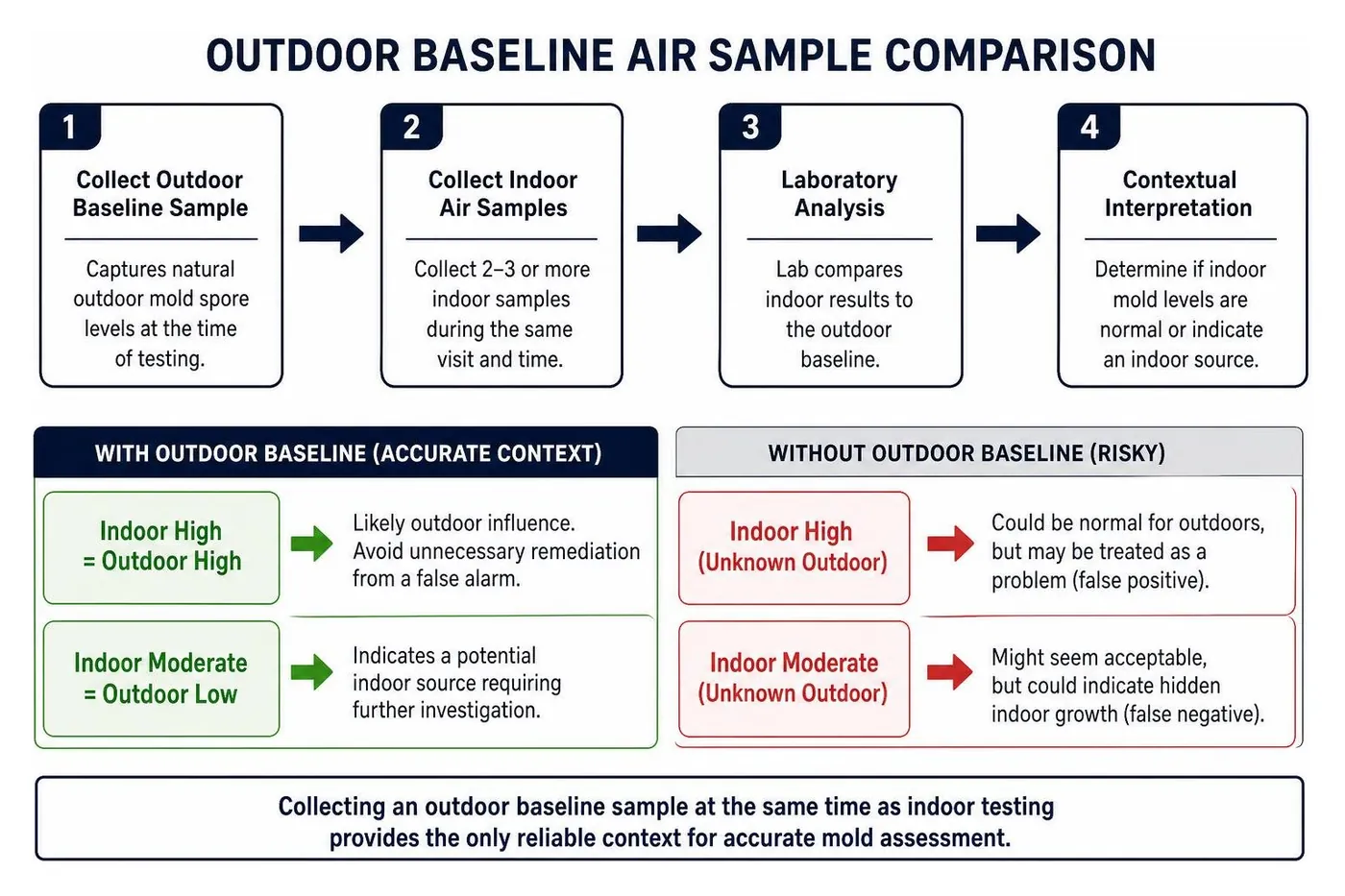
Without collecting an outdoor baseline sample at the exact same time as your indoor testing, your indoor data has no reference point.
Skipping the outdoor control sample creates two major risks:
- False positives: High indoor counts of common outdoor molds might simply mean you had a window open earlier that morning, leading you to spend thousands on unnecessary cleanup.
- False negatives: An indoor count might appear moderate on paper, but if outdoor levels for that specific species are near zero, that moderate indoor level actually indicates an active, hidden indoor colony.
A reputable inspector will never omit the outdoor baseline sample.
Potential Hidden Fees to Clarify Before Booking
To ensure you receive an accurate, all-inclusive quote, ask contractors about these potential add-on fees before scheduling:
- Separate laboratory fees: Some low-cost inspectors quote a very cheap entry price (e.g., $150) for the site visit, only to bill an unexpected $50 to $75 per sample for "laboratory pass-through charges" later.
- Rush turnaround surcharges: Standard accredited lab analysis takes 2 to 4 business days. If you need same-day or 24-hour turnaround for a real estate closing deadline, expect an expediting fee of $50 to $150.
- Extended travel fees: If your property lies outside the technician’s standard service radius, travel surcharges of $50 to $100 may apply.
- Cavity or wall sampling: Pulling air from behind drywall via specialized wall-cavity probes requires distinct hardware and tubing, which can carry a small premium ($100 to $200 per cavity sample) compared to standard room air sampling.
What You Are Paying For: Sample Types and Scope
A lab report is only as good as the physical investigation that accompanies it. Air cassettes capture what is floating in the air at a single moment in time, but they cannot tell you where water is getting in or which structural studs are rotting behind your baseboards.
A true diagnostic assessment pairs sampling with a comprehensive mold inspection, utilizing specialized diagnostic tools like pin and pinless moisture meters, relative humidity hygrometers, and infrared thermal imaging cameras to locate hidden moisture pockets.
To better understand how physical evaluations complement lab work, read our guide on the differences between mold inspection and testing.
Spore Trap Air Cassettes vs. ERMI DNA Analysis
Homeowners frequently compare standard spore trap air cassettes with Environmental Relative Moldiness Index (ERMI) tests. Both methods provide valuable data, but their applications, accuracy, and costs differ substantially.
- Spore trap air cassettes (Air-O-Cell): The industry standard for indoor air quality testing. Calibrated pumps draw a precise volume of air (typically 75 liters over 5 minutes) across a sticky glass slide. An accredited laboratory counts and categorizes the captured spores under a microscope. This test reflects current, active airborne exposure and costs between $350 and $700 for a full inspection package.
- ERMI DNA analysis: Developed by EPA researchers, ERMI uses Mold-Specific Quantitative PCR (MSQPCR) technology to analyze dust collected from carpets and surfaces. It analyzes 36 specific mold species to calculate a historic "moldiness index" for the home. While highly sensitive, ERMI tests reflect years of accumulated dust history rather than current airborne conditions. DIY ERMI kits cost $200 to $250, while professional ERMI assessments run $400 to $800+.
For general indoor air quality evaluations, real estate peace of mind, and post-cleanup clearance, calibrated spore trap air cassettes remain the gold standard.
Surface Swabs and Tape Lifts
When visible discoloration or fuzzy growth appears on a floor joist, supply vent, or drywall section, surface sampling identifies whether the staining represents active fungal growth, cosmetic wood staining, or simple household dust.
- Tape lift sampling: The technician presses clear diagnostic tape against the suspect material and transfers it to a glass slide. The laboratory inspects the sample under direct microscopy to assess spore structures and hyphal fragments.
- Swab sampling: A sterile collection swab is wiped across irregular or damp surfaces, placed into a protective transport medium, and shipped to the lab.
Surface samples generally cost $25 to $50 as an add-on or $80 to $150 as standalone tests. While surface samples confirm what is growing on a specific board, they do not measure what you are breathing; pairing surface sampling with air sampling delivers the most complete diagnostic picture.
The Assessor Independence Rule and Conflict of Interest
A critical factor impacting testing reliability is the professional separation between the assessor who tests the home and the contractor who performs the remediation.
In the restoration industry, a serious conflict of interest arises when a company offers "free mold testing" or cheap inspections with the intention of selling a five-figure remediation job. Some states, including Florida, Texas, and New York, have enacted strict licensing laws that prohibit a single company from acting as both the licensed mold assessor and the licensed mold remediator on the same property.
Even in regions without strict statutory separation, ethical environmental contractors follow rigid independence principles:
- Transparent diagnostics with zero pressure to buy remediation services
- Third-party, AIHA-accredited laboratory reports that cannot be altered or exaggerated
- Clear post-remediation clearance testing protocols to prove the environment is fully safe
Prioritizing unbiased diagnostics protects your health and your wallet, preventing unnecessary remediation expenses.
When Paying for Professional Mold Air Quality Testing Is Worth It
You do not need to test every time you spot a minor smudge of surface mold. If you see a three-inch patch of mildew on bathroom tile grout, testing is a waste of money—simply wipe it away with an appropriate cleaner and improve room ventilation.
However, professional testing is a critical investment in specific situations:
- Real estate purchases: Standard home inspectors check for general defects, but they rarely perform indoor air diagnostics. If a prospective home has a musty crawl space, a history of roof leaks, or finished basement walls, spending $400 to $600 during your due diligence period gives you powerful leverage for price negotiations or repair credits.
- Unexplained health symptoms: If family members suffer from persistent respiratory irritation, chronic sinus congestion, throat tickles, or headaches that only occur while inside the house, air testing identifies whether elevated spore counts are the trigger.
- Following major water events: After a supply line leak, roof breach, or appliance failure, moisture can seep behind baseboards and under floorboards. Air testing confirms whether hidden colonies began proliferating inside wall cavities.
- Post-remediation clearance testing: After containment and structural drying, third-party clearance testing proves that spore counts inside the workspace have dropped to normal, safe baseline levels before walls are closed up.
If you are uncertain whether your home's musty smell indicates a deeper structural issue, review our checklist on identifying signs of mold growth. When active contamination is confirmed, working with a certified team for professional mold remediation ensures the source moisture is permanently corrected.
Why a $20 DIY Kit Often Costs More
It is tempting to grab a $15 or $30 mold test kit from the local hardware store shelf. However, these consumer kits frequently cost homeowners more money in the long run due to their high rate of misleading results.
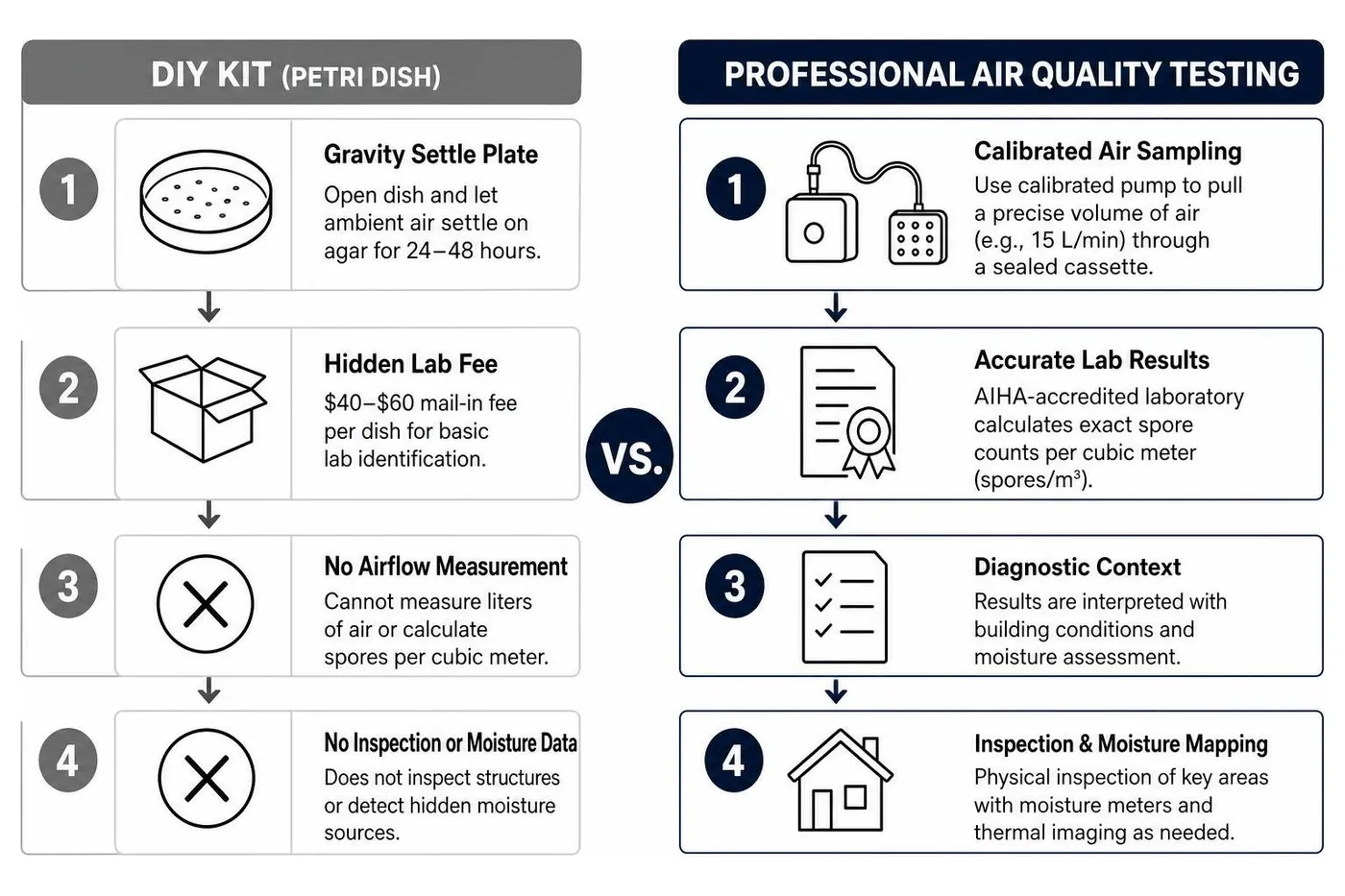
- Gravity settle plates lack airflow measurement: Hardware store petri dishes rely on gravity. You open the dish and let ambient air settle onto a potato-dextrose agar gel over 24 to 48 hours. Because mold spores are present everywhere in ambient air, something will almost always grow on an open petri dish. The kit cannot tell you how many spores were in a cubic meter of air, nor whether that growth represents a normal household background or a toxic hazard.
- The hidden DIY lab fee: The box may cost $20 at the store register, but the fine print usually requires a mandatory $40 to $60 mail-in fee per dish to receive basic lab identification. If you buy three dishes and send them in, you have spent $150 to $200 for a test with zero diagnostic context.
- Lack of calibrated pump equipment: Professional inspectors utilize calibrated rotary vane or diaphragm sampling pumps calibrated to pull exactly 15 liters of air per minute through a sealed cassette. This precision allows the lab to calculate exact spore counts per cubic meter (spores/m³).
- No moisture mapping or physical inspection: A petri dish cannot inspect your subfloor, check your attic trusses, or operate an infrared moisture meter.
Consumer Reports and professional industrial hygiene associations consistently advise against relying on over-the-counter gravity settle plates for actionable environmental health decisions.
Interpreting Lab Spore Counts and Next Steps
When your lab results arrive from an AIHA-accredited facility, you will receive a detailed multi-page document displaying raw spore counts and calculated spores per cubic meter (spores/m³).
Understanding how to read these results helps you make informed choices:
- Equal or lower than baseline: In a healthy indoor environment, total indoor spore counts are generally lower than or roughly equal to the outdoor baseline sample. Furthermore, the species distribution indoors should closely mirror the species found outdoors.
- Elevated Penicillium / Aspergillus: If indoor levels show 2,000 spores/m³ of Penicillium/Aspergillus while the outdoor baseline shows only 100 spores/m³, an active moisture issue is colonizing building materials inside the structure.
- Detection of water-marker molds: Certain heavy, sticky-spored species like Stachybotrys chartarum (often called toxic black mold) or Chaetomium do not easily disperse into outdoor air currents. Because their presence in outdoor control samples is typically zero, finding even 50 to 100 spores/m³ of Stachybotrys inside a living area strongly indicates a chronic, hidden water leak requiring targeted investigation and remediation.
Frequently Asked Questions About Mold Air Quality Testing
Does homeowners insurance cover the cost of a mold air test?
Standard homeowners insurance policies typically do not cover standalone indoor air quality testing requested for general peace of mind, real estate transactions, or slow, neglected maintenance issues.
However, if testing is required as part of a formal insurance claim resulting from a sudden and accidental covered peril—such as a burst pressurized water pipe or an appliance supply line failure—the cost of diagnostic testing, moisture mapping, and post-remediation clearance air testing is frequently reimbursable as part of the overall structural claim. Always review your policy's specific mold endorsement limits with your insurance adjuster.
How long does it take to receive professional lab results?
On-site sample collection and physical inspection take between 1.5 and 3 hours depending on property size.
Once samples are delivered to an accredited laboratory, standard optical microscopy analysis takes 2 to 4 business days. Most clients receive their completed diagnostic report, complete with inspector notes and actionable next steps, within 3 to 5 business days from the initial site visit. If you are facing an urgent real estate inspection contingency, expedited 24-hour rush lab processing is available for an additional fee.
Will one air sample show where the mold is, or do I need several?
Air sampling detects the concentration and species of airborne spores in a room, but it cannot pinpoint the exact square inch where a colony lives behind a wall.
To locate the exact source, certified inspectors follow the concentration gradient—collecting samples across multiple rooms to see where spore levels peak—and combine those findings with non-invasive diagnostic tools, including pinless moisture meters, acoustic leak detectors, and infrared thermal imaging to identify cold, damp spots inside building assemblies.
Conclusion
Investing in an indoor air quality test gives you clarity, peace of mind, and factual data about the air your family breathes. While national testing prices average between $350 and $600, making sure your test includes an outdoor baseline, calibrated sampling pumps, moisture mapping, and analysis from an accredited laboratory guarantees your investment yields clear, actionable answers.
At GM PRO RESTORATION LLC, we deliver honest, root-cause diagnostic assessments, fast turnarounds, and comprehensive environmental solutions throughout the greater Charlotte metropolitan area. Whether you are dealing with a lingering odor, buying a new home, or recovering from a plumbing leak, our certified team is here to help.
Take control of your home’s indoor environment today—schedule an expert evaluation for indoor air quality testing in Charlotte NC and breathe easier knowing your property is safe and clean.